Why we built an alternative to Guidde (and what we did differently)
Maintaining accurate process documentation is a persistent operational challenge, with many tools offering initial creation but failing to address the inevitable drift of underlying UIs. We recognized this gap and focused on building a platform that not only captures but continuously validates institutional knowledge.
Organizations frequently struggle with keeping internal process documentation current. Whether it is for onboarding new hires, standardizing customer support workflows, or ensuring engineering teams follow correct deployment procedures, reliable guides are essential. Tools have emerged to simplify the initial creation of these guides, moving beyond manual screenshot capture and text entry. However, the lifespan of such documentation, particularly in dynamic software environments, remains a significant concern.
The Initial Promise: Streamlined Guide Creation
Tools like Guidde offer a compelling solution to the initial hurdle of documentation creation. By recording user interactions, these platforms can automatically generate step-by-step guides, complete with screenshots and textual descriptions. This automation is a distinct improvement over the laborious manual process of capturing screens, annotating images, and writing descriptions from scratch. For teams that have historically relied on informal tribal knowledge or static, out-of-date wikis, the ability to quickly produce a visually rich guide can seem transformative.
The value proposition is clear: reduce the time an SME (subject matter expert) spends creating documentation. Instead of dedicating hours to drafting a single process guide, an SME can perform the task once while being recorded, and the tool outputs a draft that can be quickly refined. This efficiency gain is real and addresses a common pain point for operations, customer success, and support leaders who need to scale knowledge across their teams without overburdening their most experienced staff.
The Inherent Flaw: Static Outputs in Dynamic Environments
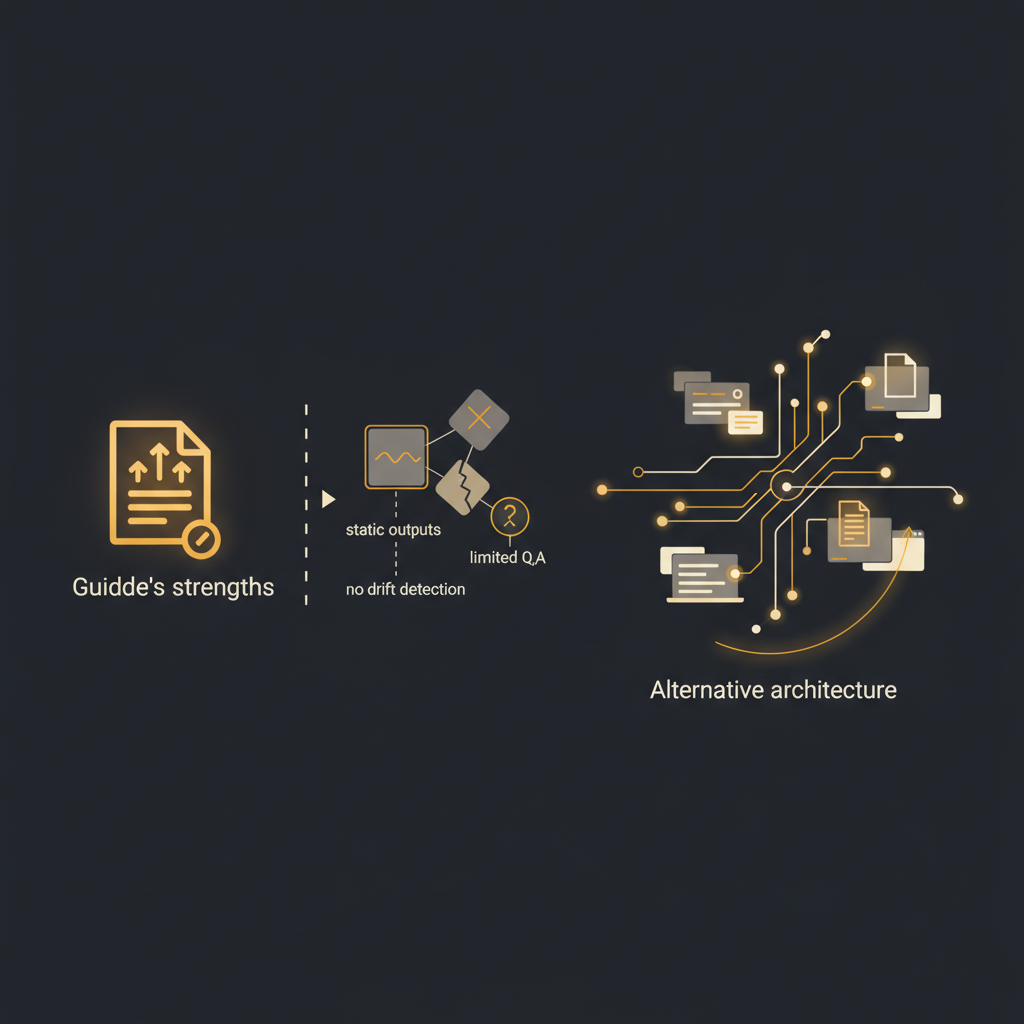
While the initial creation phase is well-addressed, the fundamental limitation of many of these tools lies in their output: static documentation. A guide, once recorded and published, becomes a fixed artifact. This presents a critical problem when the underlying software UI (user interface) inevitably changes. Even minor alterations, such as a button moving, a menu item being renamed, or a workflow step being reordered, can render a published guide inaccurate or, worse, entirely unusable.
Consider an operations team that has documented a complex CRM data entry process. If the CRM vendor updates the interface, perhaps by consolidating two fields into one or relocating a critical submission button, every step-by-step guide referencing those specific UI elements immediately becomes obsolete. End-users attempting to follow the outdated guide will encounter discrepancies, leading to confusion, errors, increased support tickets, and significant productivity loss. The perceived efficiency gained during creation is quickly eroded by the ongoing cost of maintenance.
Our observations suggest that for a moderately complex process, a single outdated guide can cost an organization between 4 to 8 hours of an SME's time per year in rework and confusion, depending on its criticality and usage frequency. Multiply this across dozens or hundreds of processes, and the 'documentation debt' accumulates rapidly, becoming a substantial drag on operational efficiency.
The Missing Layer: Proactive Drift Detection and Validation
The core architectural decision we made, which diverges significantly from static guide generation, was to integrate proactive drift detection. We recognized that the utility of any knowledge base is directly proportional to its accuracy. Therefore, a system that can not only capture how a process is performed but also detect when that process's underlying UI has changed is essential.
Instead of simply producing a video or a series of screenshots, we focused on modeling the underlying UI state at each step. This means that when a user records a workflow with Tome Robot, the system records not just the visual output, but also the structural and interactive elements of the UI. This architectural choice allows the platform to continuously monitor the application environment. If a button, a field, or a navigation path referenced in a published guide changes, the system can automatically detect this 'drift'.
This capability transforms documentation maintenance from a reactive, manual chore into a proactive, automated process. Instead of waiting for users to report broken guides, or for SMEs to manually review every piece of documentation periodically (a task rarely completed effectively), the system flags specific articles that require attention. This enables teams to address inaccuracies precisely where and when they occur, before they impact user productivity.
Beyond Simple Steps: Comprehensive Knowledge Integration
Another area where many guide creation tools show limitations is in their scope beyond simple, linear step-by-step instructions. While a 'how-to' guide is valuable, many operational questions require more nuanced answers, troubleshooting steps, or contextual information that doesn't fit neatly into a sequential format. For instance, why is a certain field configured in a particular way? What are the common error codes and their resolutions? How does this process fit into a larger business objective?
The absence of robust integration with a broader knowledge base, or limited capabilities for dynamic Q&A, means that users often have to consult multiple sources. A tool that generates only sequential guides, without a strong search, categorization, and contextual linking capability, risks becoming yet another siloed information repository. We aimed to build a system where the generated guides are not isolated artifacts, but integral components of a searchable, interconnected knowledge graph, allowing for deeper comprehension and problem-solving beyond mere execution.
"Effective knowledge management extends beyond mere instruction; it requires context, connectivity, and continuous validation."
The Operational Cost of Neglecting Drift
- Increased Support Load: Outdated guides lead to user confusion and a predictable surge in support tickets, pulling valuable resources away from more critical tasks.
- Reduced Productivity: Employees spend more time troubleshooting or seeking clarification, rather than completing their work efficiently. This directly impacts operational throughput.
- Onboarding Delays: New hires rely heavily on documentation. If these resources are unreliable, their ramp-up time extends, delaying their productive contribution.
- SME Burnout: The constant burden of manually updating documentation or answering repetitive questions drains the time and energy of an organization's most knowledgeable individuals.
- Compliance Risks: In regulated industries, incorrect or outdated process documentation can lead to compliance failures and associated penalties.
The challenge of maintaining accurate institutional knowledge in a rapidly evolving digital landscape is not new. What has changed is the technology available to address it. We chose to build a platform that directly confronts the issue of documentation decay, moving beyond simple creation to continuous validation. The goal is to ensure that the operational guides your teams rely on are not just easy to create, but consistently reliable, thereby reducing friction and increasing overall organizational efficiency.
Stop writing docs nobody reads.
Record them instead.
Install the extension, walk through the tool you're tired of explaining. Tome Robot does the rest.