Tome Robot vs. Scribe: when each one wins
Choosing documentation tools requires understanding their core strengths. This comparison unpacks when Scribe excels for quick, ephemeral guides and when a self-updating platform better serves complex, evolving organizational knowledge.
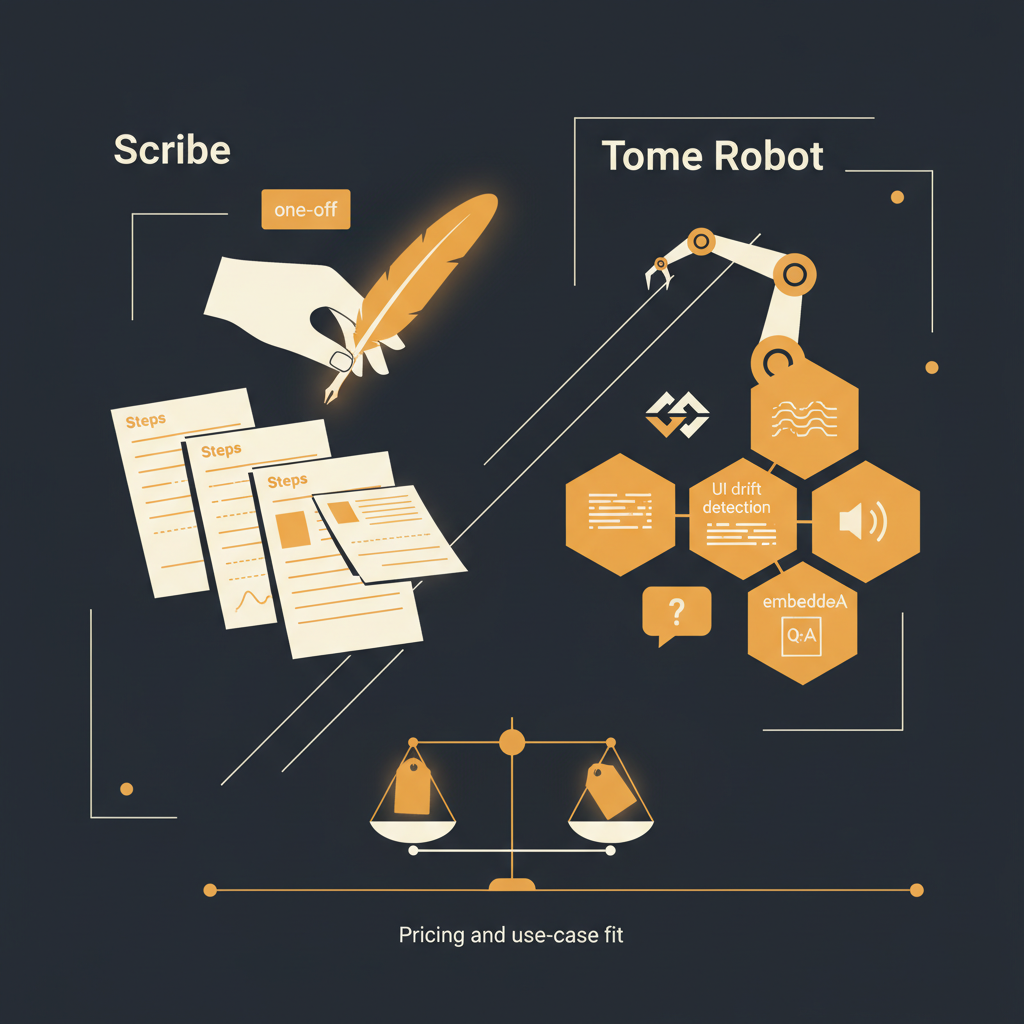
Documenting internal processes is a recurring challenge for operations, support, and engineering teams. The impulse to quickly capture a sequence of steps often leads to tools like Scribe, which promise rapid guide creation. While effective for certain scenarios, its utility depends heavily on the specific context and the intended lifespan of the documentation. This analysis will dissect where Scribe provides immediate value and where a more robust, self-maintaining knowledge solution is warranted.
Scribe's Niche: Rapid, Ephemeral Process Capture
Scribe's core value proposition lies in its ability to generate step-by-step guides with minimal effort. Users activate a Chrome extension, perform a task, and Scribe automatically captures screenshots and text descriptions for each click. This approach is highly effective for documenting straightforward, short-lived processes, or for individual contributors needing to share a quick 'how-to' with a colleague. For example, creating a guide on 'How to reset your password in our HR portal' or 'Submitting a support ticket via the new dashboard' are ideal use cases. These are processes that, while common, might only require occasional reference and are generally stable enough not to change frequently. The output is a clean, shareable document that can be embedded or linked. This simplicity makes it a valuable tool for ad-hoc, informal documentation needs, particularly when the process is unlikely to undergo significant revisions.
The Overhead of Stagnation: UI Drift and Maintenance Burden
The challenge with any static documentation, however, emerges over time: maintenance. User interfaces evolve. A button moves, a field name changes, an entire workflow is redesigned. A guide that was perfectly accurate last month can become a source of confusion and frustration today. For mission-critical operations, customer support, or complex engineering runbooks, outdated documentation is worse than no documentation; it actively misleads. Organizations often find themselves dedicating significant resources to auditing and updating manuals, a task that scales linearly with the number of processes documented and the frequency of UI changes across various platforms. This overhead quickly negates the initial time savings of rapid creation. The reality is that for every guide created, an ongoing maintenance cost is incurred, a cost rarely factored into initial tool evaluations. Without a mechanism to detect these underlying UI changes, teams are left in a reactive state, waiting for user complaints or operational errors to flag outdated content.
Beyond Static Steps: Dynamic Knowledge and Contextual Learning
Addressing the maintenance dilemma requires a shift from static capture to dynamic knowledge management. Tome Robot, for instance, not only captures the initial walkthrough but also monitors the underlying UI for changes. When a button shifts location, a field is renamed, or a step in a workflow is altered, the system automatically flags the corresponding documentation for review. This proactive detection transforms documentation from a decaying asset into a continuously validated resource. Furthermore, for complex procedures, simple screenshots and text often lack the necessary nuance. A narrated video, captured during a real team walkthrough, provides a richer context – explaining why a step is performed, not just how. This allows for a deeper understanding, akin to shoulder-to-shoulder training, but scalable. Such systems can also automatically redact sensitive information (PII) during capture, ensuring compliance without manual oversight. The ability to embed Q&A directly within the article, allowing users to ask questions that subject matter experts can answer, turns documentation into a living, evolving repository of institutional knowledge, rather than a fixed artifact. This integrated approach elevates documentation from a mere instruction set to a comprehensive learning resource.
Pricing and Strategic Fit
The financial implications of documentation tools also warrant scrutiny. Scribe typically operates on a per-user subscription model, with tiered features based on collaboration and export capabilities. This can be cost-effective for smaller teams or individuals who primarily use it for ad-hoc sharing. However, as an organization scales its documentation efforts across departments, the per-user cost for every potential document creator or even active reader can become substantial. The implicit cost of manual maintenance, as discussed, is also a hidden factor. In contrast, solutions designed for comprehensive knowledge base management often structure their pricing around the volume of knowledge (e.g., number of articles, storage) or the number of active users accessing the knowledge base, rather than solely per creator. For organizations prioritizing a centralized, reliable, and continuously updated source of truth for hundreds or thousands of processes, the total cost of ownership shifts. The upfront investment in a system with automated update detection and richer content formats (like narrated video) can be offset by significantly reduced manual maintenance hours and improved operational efficiency. The choice then becomes: pay for creation and accept ongoing manual maintenance, or invest in a system that automates much of the lifecycle management, reducing long-term operational expenditure and risk.
Ultimately, the selection between a tool like Scribe and a self-updating knowledge base hinges on the specific documentation need. For quick, informal, and transient guides, Scribe offers an undeniable speed advantage. It's a pragmatic choice for individual contributors or small teams needing to share a temporary process. However, when documentation moves from ephemeral 'how-to's' to critical, long-term organizational knowledge – impacting customer support, regulatory compliance, or core operational workflows – the requirements for accuracy, context, and maintainability escalate. In these scenarios, the long-term value of a platform that autonomously detects UI changes, integrates narrated video for deeper understanding, and fosters embedded Q&A becomes evident, transforming documentation from a static chore into a dynamic, reliable asset for the entire enterprise.
Stop writing docs nobody reads.
Record them instead.
Install the extension, walk through the tool you're tired of explaining. Tome Robot does the rest.