Building a searchable knowledge base from screen recordings: how our Q&A engine works
Building a knowledge base from screen recordings is only half the challenge. The real value emerges when users can find answers quickly, even without knowing the exact keywords. This requires a sophisticated Q&A engine that understands intent and provides precise, contextual information.
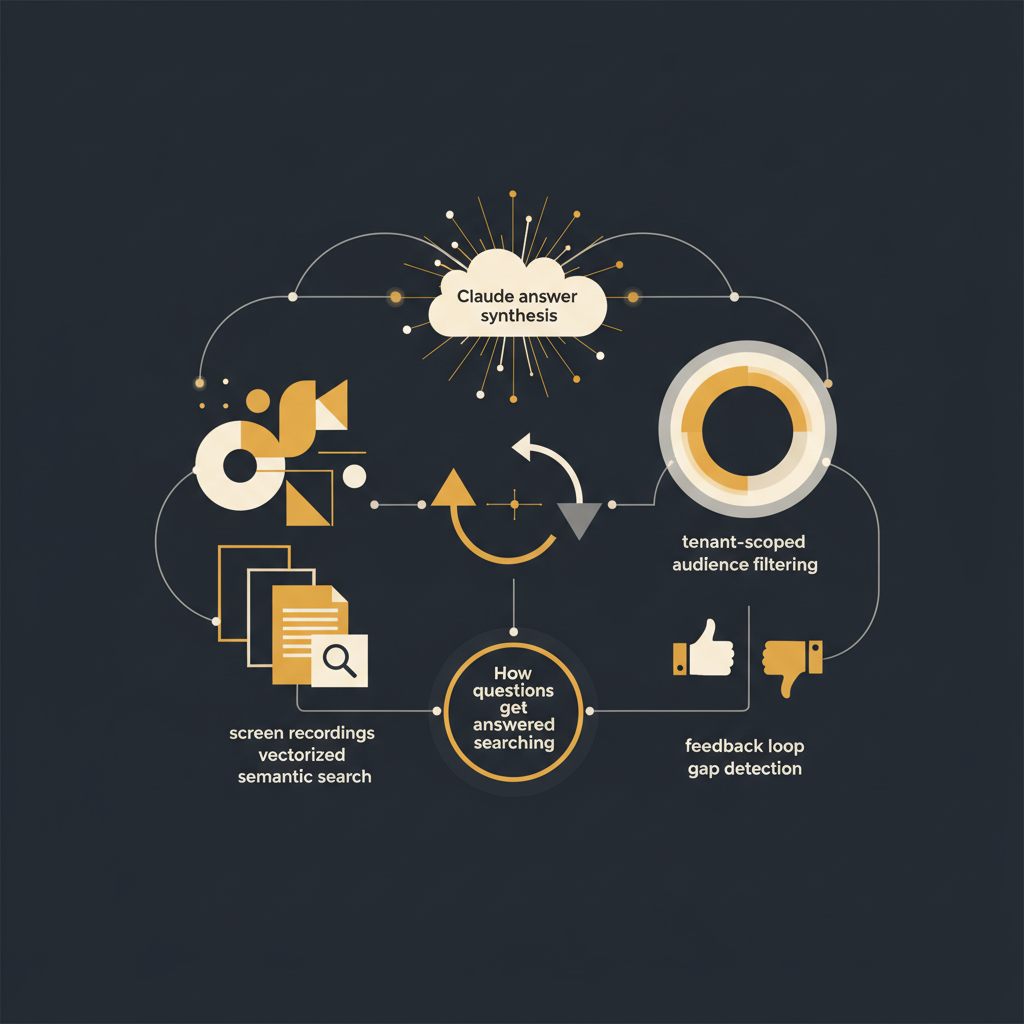
The utility of any knowledge base hinges not on the volume of information it contains, but on the ease with which users can extract actionable insights. A comprehensive collection of process documentation, built from real-time screen recordings, is a valuable asset. However, without an intelligent mechanism to navigate and synthesize this content, even the most detailed articles can remain undiscovered. The objective is to move beyond mere document storage to a system that answers questions directly, efficiently, and with context-aware accuracy. This requires a multi-faceted approach, integrating advanced search, AI synthesis, and continuous feedback loops.
Beyond Keywords: The Vectorized Semantic Search Engine
Traditional keyword search, while functional, often falls short in complex operational environments. A user searching for "close out account" might miss a relevant article titled "Finalizing Customer Records" because the exact phrase does not appear. This lexical gap significantly impedes knowledge retrieval. To overcome this, the foundation of an effective Q&A engine must be semantic understanding.
This begins with converting all knowledge base content – articles, steps, screenshots, and their associated narrations – into high-dimensional numerical representations, known as vector embeddings. These vectors capture the contextual meaning of the content, rather than just the words themselves. When a user submits a query, it undergoes the same vectorization process. The system then performs a "nearest neighbor" search in this vector space, identifying content whose meaning is most similar to the query, regardless of the precise wording used.
For example, if an engineer asks "How do I deploy a hotfix to production?" the semantic engine can identify articles discussing "emergency software release procedures" or "patching live systems," even if the term "hotfix" is absent. This approach drastically improves recall and precision, ensuring that the system surfaces genuinely relevant information that keyword-based methods would overlook. The indexing and retrieval mechanisms are optimized for performance at scale, processing millions of vectors in milliseconds to provide near-instantaneous results.
Synthesizing Answers with Large Language Models
Identifying relevant documents is the initial step; presenting a clear, actionable answer is the subsequent, critical phase. Users often seek direct solutions, not a list of articles to sift through. This is where large language models (LLMs), such as Claude, play a pivotal role. Once the semantic search engine retrieves the most pertinent sections of documentation, these snippets are fed to the LLM.
The LLM's function here is not creative generation, but rather precise synthesis and summarization. It processes the retrieved information, extracts the core steps, identifies key details, and compiles a concise, coherent answer. This process is strictly grounded in the provided source material. The LLM is instructed to derive answers only from the content it has been given, significantly mitigating the risk of "hallucinations" – fabricated information that is a common concern with unconstrained LLM use.
Consider a scenario where a support agent asks, "What are the steps for escalating a critical customer issue?" Instead of returning several long articles, the system synthesizes a bullet-point list directly from the relevant sections of the retrieved documentation, outlining the escalation path, required data points, and contact procedures. This direct answer format reduces cognitive load and accelerates problem resolution, allowing users to quickly grasp the necessary actions without extensive reading.
Ensuring Relevance and Access: Tenant-Scoped Filtering
In enterprise environments, not all information is intended for all users. Security, compliance, and operational relevance demand strict access controls. A knowledge base must be intelligent enough to filter information not only by semantic similarity but also by audience permissions and organizational boundaries.
The Q&A engine incorporates robust tenant-scoped filtering mechanisms. This means that all content is associated with specific organizational units, departments, roles, or explicit permission sets. When a user initiates a query, their identity and associated permissions are used to pre-filter the potential knowledge corpus. Only content that the user is authorized to view is even considered for vectorization and semantic search.
Furthermore, within a tenant, audience filtering refines the results. An article detailing internal engineering deployment procedures, for instance, would be flagged for "Engineering Only." A support agent querying a similar topic would either not see this article or would receive a different, higher-level overview intended for their role. This multi-layered filtering ensures that users receive answers that are not only accurate and semantically relevant but also appropriate for their security clearance and operational context. It prevents inadvertent information leakage and reduces the noise of irrelevant results, building trust in the knowledge base as a reliable source.
The Continuous Improvement Loop: Feedback and Gap Detection
A static knowledge base rapidly becomes obsolete. An effective Q&A engine must be dynamic, learning from user interactions and proactively identifying areas for improvement. This continuous evolution is driven by explicit feedback and intelligent gap detection.
- Direct User Feedback: Every synthesized answer or retrieved article is accompanied by simple feedback mechanisms, typically a "thumbs up" or "thumbs down." Positive feedback reinforces the system's understanding and ranking algorithms. Negative feedback, however, is a critical signal. It flags content that may be inaccurate, outdated, or poorly synthesized, triggering a review process by content owners. This immediate, granular feedback allows for rapid correction and refinement.
- Confidence Scoring and Re-ranking: Beyond explicit feedback, the system monitors the confidence score of its semantic matches and LLM syntheses. Low-confidence answers, even without explicit negative feedback, are flagged for human review. Similarly, articles that consistently receive low engagement or are frequently followed by further searches on the same topic suggest a lack of clarity or completeness, prompting re-evaluation and potential re-ranking in future query responses.
- Automated Gap Detection: The Q&A engine continuously analyzes query patterns. Queries that consistently yield no relevant results, or only low-confidence matches, are aggregated and highlighted as potential knowledge gaps. For instance, if many users are searching for "reset multi-factor authentication for external vendors" but no definitive article exists, this gap is identified. Combined with Tome Robot's ability to detect underlying UI changes, the system can even proactively suggest new documentation needs when a critical workflow or interface element has been modified, ensuring the knowledge base remains current.
This feedback and detection system transforms the knowledge base from a passive repository into an active, self-improving asset, ensuring its long-term utility and accuracy.
Answering Questions Before They're Asked
The pinnacle of an intelligent knowledge system is its ability to provide answers proactively, often before a user even formulates a specific question. This moves beyond responsive search to truly contextual, anticipatory knowledge delivery.
By integrating with the user's operational environment, the Q&A engine can infer intent based on the current application, the specific page being viewed, the user's role, or even their recent actions. For example, if a user navigates to the "Invoice Management" module, the system might subtly suggest articles on "Creating New Invoices" or "Processing Payments." If an error message appears, a context-aware snippet detailing common troubleshooting steps for that specific error could be presented directly within the application interface.
This proactive approach significantly reduces friction. Users spend less time searching, less time switching contexts, and more time focused on their primary tasks. It transforms the knowledge base into an ambient layer of support, providing just-in-time guidance that makes complex workflows feel intuitive and reduces the need for explicit "how-to" queries. The goal is to make the right answer appear at the precise moment it is needed, minimizing operational delays and improving overall efficiency.
Ultimately, a knowledge base's true measure is its capacity to deliver accurate, relevant, and timely answers, ideally without requiring extensive user effort. The combination of advanced semantic search, intelligent answer synthesis, stringent access controls, and a robust feedback loop transforms a collection of documents into a dynamic, intelligent Q&A engine. This allows operational, customer success, and engineering teams to access critical information precisely when and where it is needed, fostering greater efficiency and reducing operational friction.
Stop writing docs nobody reads.
Record them instead.
Install the extension, walk through the tool you're tired of explaining. Tome Robot does the rest.