Export everywhere: Markdown, HTML, and SCORM from a single recording
Maintaining accurate procedural documentation across disparate systems like wikis, internal portals, and Learning Management Systems often means redundant authoring. A single source recording can now generate Markdown, HTML, and SCORM packages, eliminating wasteful content duplication.
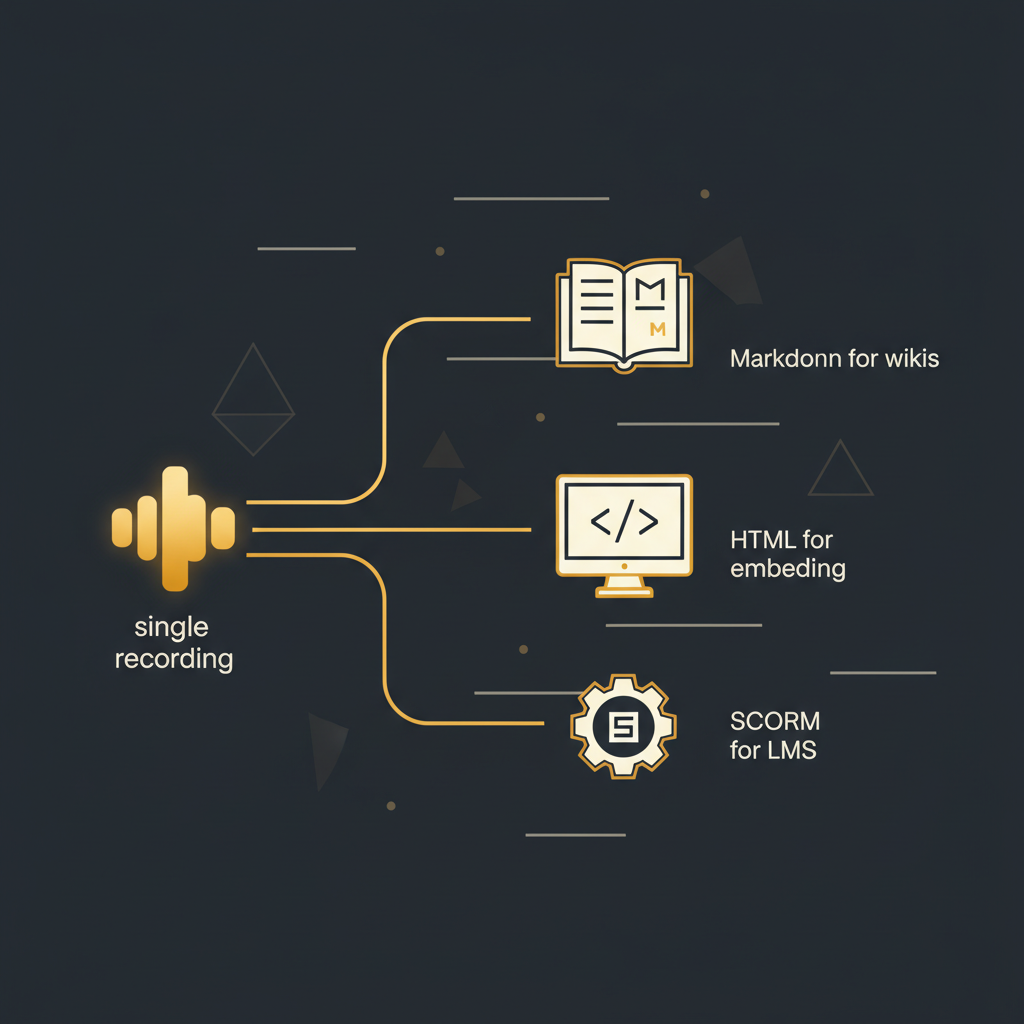
Organizations frequently grapple with a fragmented approach to knowledge management. A process documented for an internal wiki (Confluence, Notion) often needs to be reformatted for a customer-facing support portal, and then re-authored entirely for a Learning Management System (LMS). This duplication of effort is not merely inefficient; it introduces inconsistencies and significant maintenance overhead. The conventional wisdom has been to accept this as an unavoidable cost of doing business. However, a single source of truth for procedural content can serve multiple destinations.
The Undeniable Cost of Content Replication
Consider the typical journey of a critical operational process. An engineering team documents a new deployment procedure in Markdown within their Git repository or a developer wiki. The operations team then extracts relevant steps, likely rephrasing or reformatting them, for inclusion in an internal runbook system or an operational portal. Meanwhile, the customer support team needs a simplified version for their knowledge base, perhaps embedding it directly into their support application. Finally, the Learning & Development (L&D) department must create a structured course module for new hires, complete with assessments and tracking capabilities, requiring yet another re-authoring into a SCORM-compliant package.
Each of these re-authoring cycles introduces points of failure. A change in the original procedure requires updates in three, four, or even more locations. The median time to update a single piece of documentation across an enterprise can easily exceed an hour, especially when multiple stakeholders are involved. For an organization with hundreds or thousands of procedures, this translates into thousands of wasted hours annually, not to mention the risk associated with outdated information.
Markdown: The Foundation for Structured Knowledge
For many teams, especially in engineering and operations, Markdown is the lingua franca of documentation. Its plain-text, human-readable syntax makes it ideal for version control systems, internal wikis, and collaborative platforms. When a process walkthrough is captured, the ability to export that sequence of steps, screenshots, and narration directly into Markdown offers immediate utility. This is not merely a text dump; it involves structuring the content with appropriate headings, bullet points, and code blocks that are native to Markdown.
For instance, an engineering leader overseeing complex build processes might require every operational runbook to reside in a Git-backed wiki for auditability and easy collaboration. Automatically generating a Markdown file from a recorded walkthrough means new procedures can be integrated into existing documentation workflows with minimal friction. This ensures that the primary source of operational truth remains consistent and immediately available for developers and SREs, without needing a dedicated technical writer to translate a video or a series of screenshots into a structured document.
HTML: Seamless Integration and Embedded Experiences
While Markdown serves internal, structured knowledge bases well, there are numerous scenarios where interactive, web-embeddable content is superior. Customer success teams often need to embed step-by-step guides directly into their CRM or help desk software. Product teams might integrate short tutorials into their application's onboarding flow. In these cases, a pure HTML export of a recorded procedure provides the flexibility needed.
An HTML export allows for a rich display, preserving the original formatting, screenshots, and sequential flow of the captured walkthrough. This output can be dropped into any web-based platform, an intranet, a customer portal, or even an email campaign. The benefit here is that the content is self-contained and ready for immediate deployment. There is no need for complex API integrations or custom development to render the instructional material. A support leader can quickly generate an HTML guide for a common customer issue and embed it directly into an FAQ section, ensuring customers receive accurate, visual instructions without navigating away from their current support channel.
SCORM: Meeting Learning & Development Requirements Without Re-Authoring
Perhaps the most significant challenge in knowledge dissemination is the creation of formal training modules, particularly for compliance or certification. Learning & Development (L&D) departments rely heavily on the Sharable Content Object Reference Model (SCORM) standard for their Learning Management Systems (LMS). SCORM packages allow for standardized communication between content and the LMS, enabling tracking of user progress, completion, and assessment scores. Historically, creating SCORM-compliant content has been a specialized, time-consuming process, often requiring dedicated e-learning authoring tools.
This is where the concept of single-source content becomes truly transformative for L&D. Imagine recording a critical operational procedure once. From that single recording, a complete, interactive SCORM package can be generated. This package includes the narrated steps, visual cues, and even automatically generated quiz questions to test comprehension, all wrapped in a format ready for upload to any SCORM-compliant LMS. This eliminates the arduous task of manually recreating content in a separate authoring tool, drastically reducing the time and resources spent on training material development and maintenance.
For example, a new hire onboarding process for a complex software system might require 20 distinct procedural guides. Manually building these into SCORM modules could take hundreds of hours. If each guide can be generated as a SCORM package directly from a recorded walkthrough, the L&D team can focus on instructional design and assessment strategy, rather than content re-authoring. This ensures training content is not only accurate and up-to-date, but also consistently delivered and trackable, directly addressing audit and compliance needs.
Consistency Through Centralization
The ability to generate multiple, industry-standard content formats from a single source recording simplifies a complex problem. It means that an update to a core process needs to be performed only once, and that change propagates to every output format. This approach reduces redundant work, improves content accuracy across all platforms, and significantly lowers the operational burden associated with maintaining up-to-date documentation. It allows organizations to establish a unified source for procedural knowledge, ensuring that whether content is consumed in a developer wiki, an embedded support widget, or a formal LMS course, it originates from the same validated record.
Stop writing docs nobody reads.
Record them instead.
Install the extension, walk through the tool you're tired of explaining. Tome Robot does the rest.